Lovable Cloud


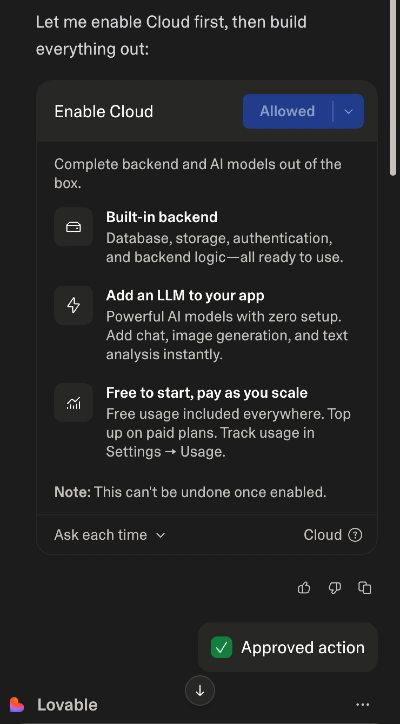
Lovable, the european unicorn, just released their Cloud offering called Lovable Cloud & AI, it is free to experiment for one week! They use Supabase for the database, authentication, and storage. You can ask APIs to go through REST or GraphQL.
Lovable is great for PM to build quality client-only prototypes (no backend), and demo 2-3 prototypes to customers. Now we need to pay attention to our prompt and context, because Lovable will try to bake the backend and the LLM in by default! Lovable chat is quite explicit about it, and will ask for your permission, ponder your response accordingly.
Here are two apps I built, generating a recipe based on the ingredients you provide, and hopefully have in your fridge. Both built with Lovable,
- Magic Recipe #1 is the frontend-only prototype, connecting to an Agentic workflow using a model from Anthropic Claude API (external to Lovable).
- Magic Recipe #2 is the fullstack prototype, with the backend and LLM baked in by Lovable Cloud.
From a pure functionality perspective, both run perfectly fine. My prompt and requirements have been respected. The user would not notice the difference. Now the backend architecture is widely different. The first prototype was longer to build as I had to wire the workflow and model manually. Lovable takes care of this in the second, clearly saving time. This is a prototype to gather user feedback, not an MVP. However your engineering team may decide to select Lovable's infrastructure and backend to run this product, at scale. And the two questions come to mind:
1. How many tokens does Lovable consume between 1 and 2? That will depend on your prototype complexity. The example here is super simple, the amount of tokens is negligible. Your mileage may vary.
2. How does it scale to an army of product teams using Lovable backend to support their minimal product? I cannot answer that yet. That's an interesting study to run!
PS: the LLM is sometime long to respond and make the generation fail, just retry your prompt until you feel lucky (Google old days...).